Drizzle ORM vs. Prisma: How They Model Relations and Foreign Keys Under the Hood
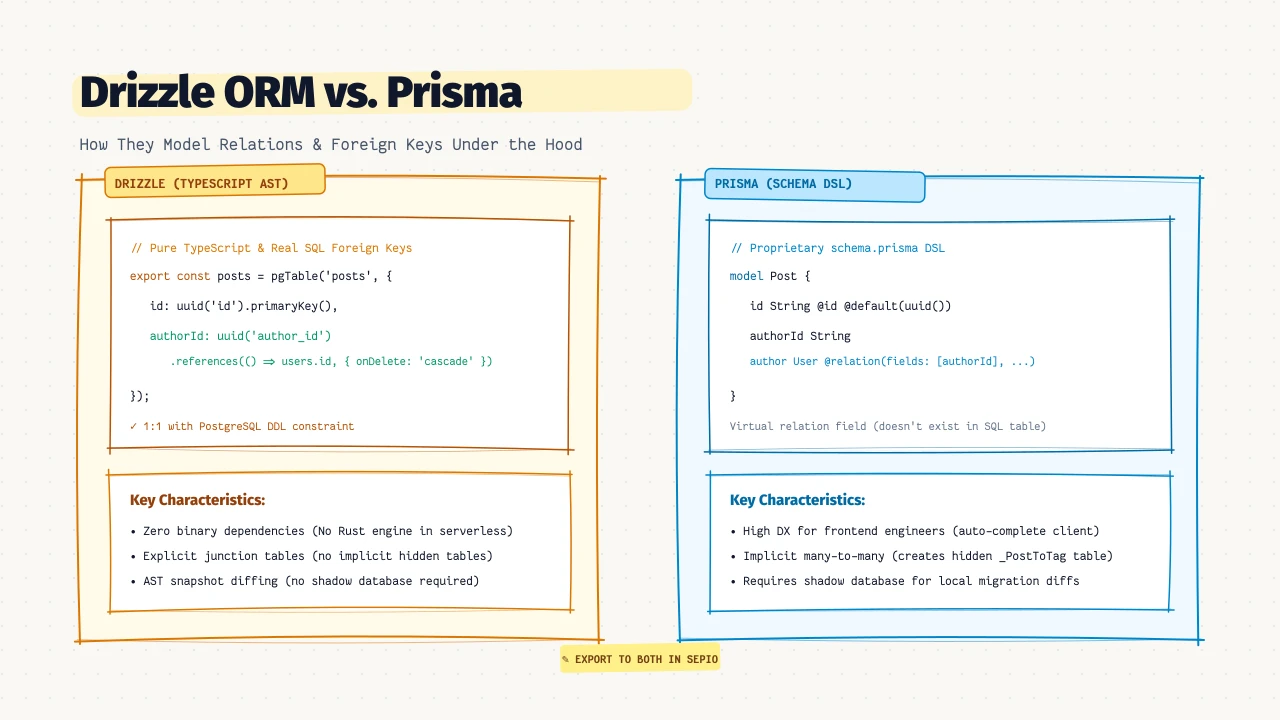
The TypeScript ORM Paradigm Shift
The JavaScript and TypeScript ecosystem has undergone a massive evolution in how developers interact with relational databases. For years, Prisma reigned supreme as the gold standard for developer experience. Its custom schema modeling language (schema.prisma), auto-generated client, and intuitive relation syntax changed how frontend and fullstack engineers approached SQL.
Recently, Drizzle ORM has exploded in popularity, offering a radically different philosophy: “If you know SQL, you know Drizzle.” Instead of introducing a custom DSL, Drizzle defines schemas directly in standard TypeScript using native database dialect constructs.
“Prisma created a wonderful abstraction that hid the database from frontend engineers. Drizzle showed that when TypeScript types mirror SQL syntax directly, the database becomes an asset rather than an abstraction leak.” — Staff Backend Architect at FinTech Platform
While dozens of articles compare query syntax (prisma.user.findMany() vs. db.select().from(users)), very few explore what actually happens under the hood during schema definition, relationship mapping, and migration generation.
Here is how Drizzle ORM and Prisma model relationships, foreign keys, and constraints—and the critical trade-offs you make when choosing between them.
1. Virtual Application Relations vs. Database Relational Constraints
The most fundamental architectural difference between Prisma and Drizzle lies in how relationships are declared and enforced.
How Prisma Does It: The Virtual @relation
In Prisma, relationships between models are declared using Prisma’s proprietary schema language. You define virtual fields on both sides of the relationship:
// schema.prisma
model User {
  id        String   @id @default(uuid())
  email     String   @unique
  posts     Post[]   // Virtual field (does not exist in SQL table)
  createdAt DateTime @default(now())
}

model Post {
  id        String   @id @default(uuid())
  title     String
  authorId  String   // Actual foreign key column in database
  author    User     @relation(fields: [authorId], references: [id], onDelete: Cascade)
}
What happens under the hood:
posts Post[]on theUsermodel is completely virtual. It has no corresponding column in the PostgreSQL table. It exists solely to instruct the Prisma Client code generator to attach nested relation queries.- Prisma uses its Rust-based engine (or newer WebAssembly driver adapters) to parse this schema, resolve the back-references, and generate query plans.
- If you use Prisma with databases or connection configurations that disable foreign keys (such as PlanetScale’s
relationMode = "prisma"), Prisma enforces referential integrity entirely in the application layer using multiple SQL queries.
How Drizzle Does It: Native SQL AST + Pure TypeScript
Drizzle takes the opposite approach. Your schema is pure TypeScript, and every statement maps 1:1 with an actual SQL clause:
// schema.ts (Drizzle ORM with PostgreSQL)
import { pgTable, uuid, varchar, text, timestamp } from "drizzle-orm/pg-core";
import { relations } from "drizzle-orm";

// 1. Physical Table Definitions (SQL DDL 1:1)
export const users = pgTable("users", {
  id: uuid("id").primaryKey().defaultRandom(),
  email: varchar("email", { length: 255 }).notNull().unique(),
  createdAt: timestamp("created_at", { withTimezone: true }).defaultNow(),
});

export const posts = pgTable("posts", {
  id: uuid("id").primaryKey().defaultRandom(),
  title: text("title").notNull(),
  authorId: uuid("author_id")
    .notNull()
    .references(() => users.id, { onDelete: "cascade" }), // Real SQL Foreign Key!
  createdAt: timestamp("created_at", { withTimezone: true }).defaultNow(),
});

// 2. Application-Level Query Relations (Optional Drizzle Relational Queries)
export const usersRelations = relations(users, ({ many }) => ({
  posts: many(posts),
}));

export const postsRelations = relations(posts, ({ one }) => ({
  author: one(users, {
    fields: [posts.authorId],
    references: [users.id],
  }),
}));
What happens under the hood:
references(() => users.id)produces an actual PostgreSQLFOREIGN KEY (author_id) REFERENCES users(id) ON DELETE CASCADE.- The physical database constraints and the application-level query relations are cleanly decoupled. If you only want standard SQL joins (
db.select().from(posts).leftJoin(users, ...)), you don’t even need to declarerelations(). - There is no Rust binary or code generation step. TypeScript’s type inference engine directly computes the return types of your queries at compile time.
2. Many-to-Many Relationships: Implicit vs. Explicit
Modeling many-to-many relationships (e.g. Posts and Tags) highlights the contrasting philosophies of the two tools.
Prisma Implicit Many-to-Many
Prisma allows developers to declare a many-to-many relationship without manually defining a junction table:
model Post {
  id    String @id @default(uuid())
  tags  Tag[]
}

model Tag {
  id    String @id @default(uuid())
  posts Post[]
}
Under the hood, prisma migrate automatically creates a hidden junction table named _PostToTag with columns A and B and creates foreign key constraints and compound indexes.
While convenient for prototyping, this becomes an operational problem in production:
- You cannot easily add extra columns to the junction table (such as
assigned_at,assigned_by, ororder_index) without destroying the implicit relation and manually migrating data. - The default column naming (
A,B) makes raw SQL analytics queries awkward.
Drizzle Explicit Junction Modeling
Drizzle does not support “implicit” junction tables because SQL has no concept of an implicit table. You define the junction table explicitly:
import { pgTable, uuid, timestamp, primaryKey } from "drizzle-orm/pg-core";

export const postTags = pgTable("post_tags", {
  postId: uuid("post_id").notNull().references(() => posts.id, { onDelete: "cascade" }),
  tagId: uuid("tag_id").notNull().references(() => tags.id, { onDelete: "cascade" }),
  assignedAt: timestamp("assigned_at", { withTimezone: true }).defaultNow(),
}, (table) => [
  primaryKey({ columns: [table.postId, table.tagId] }), // Composite Primary Key
]);
Because it is explicit from day one:
- Adding metadata columns requires zero schema refactoring.
- Composite primary keys and custom indexes are transparent.
- Tools like Sepio can visually render junction nodes and cardinality lines with 100% precision.
3. Migration Engines & Schema Drift
How do your schema changes make it to production?
| Dimension | Prisma (prisma migrate) |
Drizzle (drizzle-kit) |
|---|---|---|
| Migration Format | SQL files + _prisma_migrations shadow table |
Pure SQL files + meta/_journal.json snapshot |
| Shadow Database | Required for local development migration diffing | Not required (uses pure AST snapshot diffing) |
| Edge / Serverless Runtime | Requires Prisma Accelerate or WASM engine adapters | 100% native JavaScript/TypeScript (zero binary dependencies) |
| Schema Source of Truth | Proprietary .prisma file |
Standard .ts TypeScript source code |
Prisma’s migration engine creates a shadow database locally to detect schema drift and generate diffs. This ensures safety but requires database creation privileges and creates overhead in containerized CI environments.
Drizzle-Kit computes migration diffs by comparing TypeScript Abstract Syntax Tree (AST) snapshots against historical JSON schemas, making it instant and capable of running without a shadow database.
Visualizing Both in Sepio
One of the historical pain points of database modeling has been bridging visual diagrams with ORM code.
With Sepio, you don’t have to choose between visual design and code fidelity:
- Design on Canvas: Create tables, add composite keys, and draw relationships.
- Export to Either: Toggle between Drizzle ORM (TypeScript) and Prisma (
schema.prisma) in one click. - Bi-directional Sync: Paste your existing Drizzle or Prisma schema directly into Sepio to inspect your architecture visually.
Frequently Asked Questions
Is Drizzle faster than Prisma?
In serverless and edge environments (AWS Lambda, Cloudflare Workers, Vercel), Drizzle has near-zero cold start overhead because it is a lightweight TypeScript library with no binary engine. In long-running servers, Drizzle generally has lower memory consumption and faster query serialization, though recent Prisma versions with Driver Adapters have significantly narrowed the query latency gap.
Can I migrate an existing Prisma project to Drizzle?
Yes. You can run npx drizzle-kit pull against your existing PostgreSQL or MySQL database to reverse-engineer your current tables into Drizzle TypeScript files. Alternatively, import your Prisma schema into Sepio to visually audit your constraints before exporting to Drizzle.
Does Drizzle support composite foreign keys?
Yes. Drizzle supports composite foreign keys using the foreignKey() table configuration callback, whereas Prisma handles composite relations via @@relation(fields: [a, b], references: [a, b]). Sepio’s visual linter validates composite foreign key pairings in real time.